
Oregon Resident Search Steps
Oregon has no one public roll that names each resident. A useful search moves among records created for distinct purposes: the assessor tracks parcels and owners, the county clerk handles elections and some county records, and the courts keep case files. State offices issue vital records and business filings. Libraries, city archives, and the State Archives help with older names, addresses, and events. Start where the record was made. A property question belongs with the county where the land sits; a court case belongs with the court that heard it. Together, these separate rolls form the working Oregon residents directory, but no single source covers every household.
Keep the question narrow. A name plus a county can guide a first search; an address and rough year can help with an older household. Record the date and source of each result. An owner's tax mailing address is not proof that the owner lives on the parcel, and a voter entry shows registration data, not a person's daily whereabouts. If one source gives a likely match, use another custodian to check the time, place, or relationship before treating it as the same person.
- Write down the county, city, exact name, address, and time period tied to the question.
- Check the county assessor for the parcel and owner of record, then note the situs and mailing addresses separately.
- Use Oregon My Vote for an individual registration check, or follow the county clerk's route for voter records.
- For a court or vital event, go to the court or health-record custodian that holds that record type.
- When online coverage ends, ask the custodian, county research room, library, or State Archives about the next search channel.
- Roll
- A list kept for one purpose, such as tax accounts or voter registration.
- Index
- A finding aid that points to a record; it may not include the full document.
- Parcel
- A mapped piece of land identified by a tax lot or property number.
- Criss-cross directory
- A directory section arranged by address so a reader can search a street rather than a surname.
Oregon's Record Offices
Oregon divides local property, deed, tax, and many election records among 36 counties. The county where a parcel or case belongs is the first stop; the statewide offices below cover separate duties and can direct a search to the right custodian. The Oregon Historical County Records Guide lists older county series and where they are held. For current parcel-by-parcel work, the Oregon street directory follows the address trail in more detail.
Oregon State Archives
800 Summer St. NE
Salem, Oregon
503-373-0701
Historical Records Index
Oregon Vital Records
OHA Center for Health Statistics
P.O. Box 14050, Portland, Oregon 97293
1-888-896-4988
Certified birth and death records
Oregon Elections Division
255 Capitol St. NE, Suite 126
Salem, Oregon
503-986-1518
Oregon My Vote registration service
The State Archives reference room in Salem is open on weekdays from 8:30 a.m. to noon and 1 p.m. to 4:30 p.m. Staff can point to a book, reel, or county repository, while the local office remains the keeper of many current records. The Oregon public-records request hub links to agency procedures when a record is not online. Under ORS 192.311–192.478, agencies respond as soon as practicable and without unreasonable delay; fees may reflect staff time, copies, redaction, and delivery. A written estimate is generally required before work proceeds when the estimate exceeds $25.
Oregon's 36 County Record Map
County lines matter because Oregon has no statewide owner-name property portal and no single deed index. The State Archives guide covers all 36 counties, but the online tools and older record rooms differ. A record may sit with a county clerk, recording division, assessor, treasurer, circuit court, or a local archive. Portland is one inspected example, not a statewide pattern. Its public research room has older recording material that is outside the online date range; another county may use a different portal or keep its books at the courthouse.
For a name tied to land, first identify the county where the parcel lies. For a marriage or probate file, use the county of the event or court case. If the present office cannot find an older volume, ask which repository holds that series and what dates it covers. The Archives guide can point to a State Archives collection, county records center, library, museum, or historical society. That location check saves time when an old town name, rural route, or postal city makes the jurisdiction unclear.
Search online first, then contact the county office by phone or visit its public terminal or counter if available. A targeted written request can ask for a non-exempt record that is not posted; a library or archive desk may identify the older book or index before a copy request is sent. Oregon Public Records Law requires a timely response, but a copy may carry a reasonable fee for staff time, review, redaction, or delivery.
Note: County offices differ in portal coverage and counter access, so check the local custodian's current instructions before planning a visit.
Current Oregon Resident Records
Modern Oregon records are partial views, not one complete directory. Each source has a defined purpose and a different custodian. Read its label before using an address or name as a lead. The Oregon residents directory is best treated as a route among these official records, not as a roster that any one office maintains.
| Record source | What it can show | Keeper | Route |
|---|---|---|---|
| Assessor and tax roll | Owner of record, parcel, situs and mailing address | County assessor | County portal or records request |
| Voter registration | Registration status and public registration details | County clerk and Oregon Elections | My Vote or voter-list request |
| Recorded documents | Names and roles on deeds, liens and other filings | County recording office | County index, research room or copy request |
| Court register | Case parties, dates, events and judgments | Oregon Judicial Department | Free search, OJCIN or courthouse terminal |
| Business and license filings | Entity, agent or licensee links | Oregon Secretary of State and agencies | Public search; not a residence list |
A property roll answers who owns a parcel, while registration data describes a voter's record and a deed index shows parties to a legal filing. None names every adult or child in a home. A case result is tied to an event in court, not to present-day residence. Business addresses may be agent or notice locations. Keep these meanings apart when checking one person's record so a lead from one system is not mistaken for proof in another.
Oregon Assessor Search Fields
PortlandMaps is a detailed local example for property research. Its advanced assessor form can take an address, Property ID, State ID, neighborhood, city, alternate account number, ZIP, or legal description. It also accepts ranges for building year, square footage, sale date, and market value. The City warns that PortlandMaps reflects local data; other Oregon counties may offer different fields.
PortlandMaps Advanced Assessor Search shows the form before a parcel result is chosen.
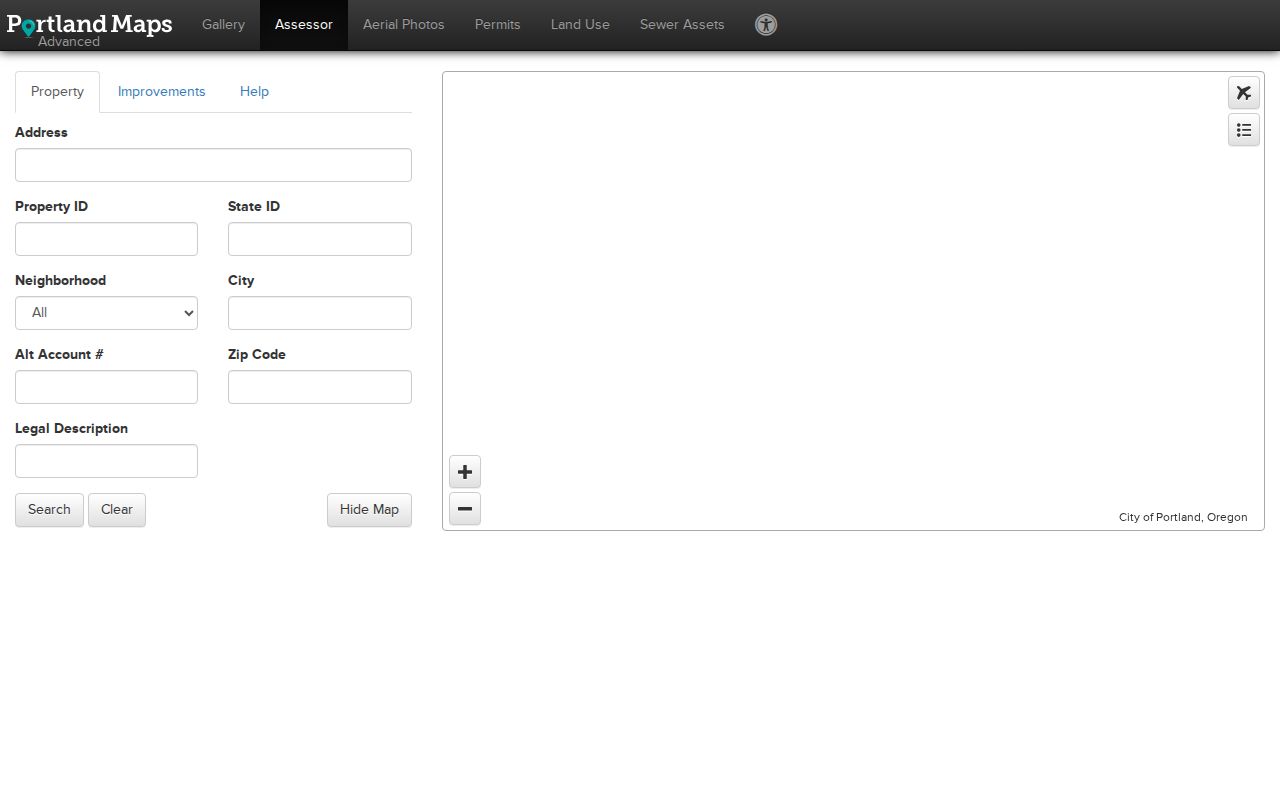
The form can require a search term longer than one character, and results can be sorted, paged, or downloaded as CSV, JSON, or XML. A map result helps tie the record to land; it still does not show every person who lives there.
| Field | Type | Required | Use |
|---|---|---|---|
| Address | Text | Optional | Enter an address clue. |
| Property ID / State ID | Text | Optional | Use a known local or state identifier. |
| Neighborhood / City | Select or text | Optional | Limit the search by local place. |
| Alt Account # / Zip Code | Text | Optional | Use another account key or delivery ZIP. |
| Legal Description | Text | Optional | Search the recorded land description. |
| Built year / square footage | Number range | Optional | Filter by improvement age or size. |
| Sale date / market value | Date or number range | Optional | Narrow by transaction or value. |
Oregon Voter File Access
Oregon My Vote checks an individual's registration with a first name, last name, and date of birth. It can display the public registration details available for that voter. The county clerk maintains the record, and address-confidentiality exemptions can hide a protected residence. A current result is still a registration record, not proof that a person is at home or that every household member is listed.
Oregon also allows a voter-list request through the Secretary of State. A statewide electronic file is $500; a less-than-statewide file has a $25 setup fee plus 2.5 cents per 100 records, with a usual 10-business-day estimate. The list's contents and use are governed by ORS 247.940–247.955, including a ban on commercial use except for the statute's political exception. The official voter-list request page explains the request route and delivery.
Note: My Vote is an individual registration check, while a voter-list request follows separate cost, delivery, and use rules.
Oregon Court Search Levels
The Oregon Judicial Department's free case search gives basic case information and calendars for circuit, Tax, appellate, and Supreme Court matters. It lists events such as filings, hearings, notices, and judgments, but does not provide the filed documents themselves. Adoption, juvenile, mental-health, and some protected cases are not open in the ordinary search.
| Route | What it offers | When to use it |
|---|---|---|
| Free OJD search | Basic case details and calendars | Start with a name or known case number |
| OJCIN Online | Paid OECI and ACMS access, including registers | When the basic result lacks a needed case event |
| Local court terminal or clerk | Public access and copy routes | When the online search or a document is not enough |
The circuit-court clerk holds the file. A routine copy is listed at 25 cents per page and certification adds $5; the court provides an estimate when likely fees exceed $25. A same-name result should be compared by court, date, case type, and other lawful details before it is linked to a resident.
Oregon's Historical Directory Shelf
Portland's first city directory appeared in 1863. The early volumes list names alphabetically but lack the later street-by-street section. From 1930 forward, Portland volumes include a reverse Street and Avenue Guide that can connect an address to a name for that year. Multnomah County Library holds local directories in its Central Library history collections, while Gresham Library has local runs for that area. The Oregon city directory collections page explains the years, formats, and ways to search a past household without treating an old address as current.
Oregon's records have also moved across offices and formats. The State Archives County Records Guide grew from a statewide historical-records project that drew on earlier WPA inventories. County books, library volumes, archive catalogs, and newspapers may each hold one piece of the same trail. A directory lists a household or business as printed, not a complete census; compare its names and address with a census, deed, or obituary for the right year.
Oregon Vital Records by Era
Birth, death, marriage, and divorce records have different access rules. The Oregon Health Authority issues certified records, while libraries and the State Archives hold historical indexes. A name index is not the same as a certificate, and eligibility for a recent copy is not the same as access to an older record.
Oregon restricts birth records and indexes for 100 years and death certificates for 50 years. The State Archives vital-record guide describes the historical route. In 2026, the Archives noted that 1925 births, 1975 deaths, and 1975 marriage and divorce returns had opened under the rolling schedule. Check the current custodian before ordering because each January changes the eligible year.
- Birth record
- Recent certified copies require identity and relationship eligibility; historical access follows the 100-year rule.
- Death record
- Oregon's death index at libraries runs through 2008, while certificate access follows the 50-year rule.
- Marriage or divorce
- A vital record or index can point to an event; a full divorce file belongs to the circuit court.
Note: The record's opening year advances with the calendar, and certificate eligibility can differ from index access.
Oregon Archives and Name Variants
The Oregon Historical Records Index helps locate early names, estates, land claims, marriages, and other state or county series. Its entries preserve spelling as found in the source. The Archives recommends searching a surname first, then narrowing with a given name or county; periods are not useful in this database, and old entries may shorten a given name such as William to Wm. An index hit directs the next search. It may name a reel, book, or repository rather than show an image.
For an older county record, check the State Archives guide for the series description, date span, restriction, and holding office. Salem reference staff can help route a search, and local libraries or historical societies may have books, microfilm, newspaper indexes, or a catalog record that does not appear in the statewide index. When a name seems to disappear, test a spelling variant and the county boundary at the time instead of assuming the record was lost.
Oregon Heirs and Unclaimed Property
Oregon State Treasury offers a free name search for unclaimed property and a separate estate-administration path when the state handles an estate with no known heir. A former address or a similar name can be a lead for family-history work, but it does not establish who owns an asset. A claimant must provide proof of identity and the relationship or authority required for that claim.
For an estate, check the circuit-court probate register and the recorded deed trail as well as an obituary. The court can show a case, executor, and filed events; the recorder can show a later transfer; the newspaper may explain a family link. Keep the living person's contact details private. The official Oregon unclaimed-property search is the starting point for a claim, and no fee is needed to search the state program itself.
Oregon Addresses Cross County Lines
In Oregon, a postal city, incorporated city, county, neighborhood, tax-lot jurisdiction, and physical site can point to different boundaries. The 2025 Oregon Address Point Standard describes 241 incorporated cities, 36 counties, nine tribes, and six regional councils of governments; local authorities create address points. ZIP Codes do not follow city limits, and the standard lists 479 Oregon ZIP Codes, all beginning with 97.
Use the USPS ZIP Code Lookup to check an address or postal community, then use the county assessor or local map to identify the parcel and jurisdiction. A ZIP result confirms a delivery format, not the person at that address. In Portland, the old five-quadrant street system grew from a 1931–1933 reassignment. A current number may not match the one printed in an older directory. The 1933 cross-reference at the Portland City Archives can connect the old and new forms.
The geographic pattern is useful when tracing a family across time. Gresham and East Suburban directories include areas that later became part of Portland, while rural Tscheu directories use route boxes instead of present-day street numbers. Check the city or county that held the land in that year, not only the name printed by the post office.
Note: A familiar postal city name may cross a city or county line, so confirm the local jurisdiction before ordering an older record.
Oregon Privacy and Address Shields
Oregon's public records carry safety limits as well as access rights. The Address Confidentiality Program gives qualifying survivors a substitute mailing address. A registered voter may apply for a residence-address exemption using SEL 550 through the county clerk; evidence may include an ACP card, police report, court order, medical record, or affidavit. These protections mean a missing address can reflect a lawful exemption, not a failed search.
The Oregon Consumer Privacy Act, ORS 646A.570–646A.589, gives covered residents rights to access, correct, copy, delete, and opt out of certain data uses by covered businesses. It does not erase government records held by a county or court. The Oregon DOJ privacy guide explains the business-request process and the state data-broker registry. Use public sources for lawful personal, family, estate, or civic research, and do not use a record to follow or intimidate a person.
Respect privacy. Public access does not make a name or address a tool for harassment. Use a custodian's correction or exemption process when a record is wrong or safety is at stake.
Oregon's New Digital Record Paths
The Oregon State Library moved more than 160,000 government publications to a full-text digital platform in October 2024. Northwest Digital Heritage announced one million digital cultural-heritage records in March 2025, drawn from more than 300 libraries, museums, and heritage groups across the Northwest. These collections add newspapers, photographs, letters, and local records that a modern assessor or court search will not return.
Use a digital search as a way to locate a source, then follow the item back to its holding repository and check its date and access terms. A digitized newspaper can surface an obituary or an old street name; a county guide can point to the original ledger. The platform does not replace the custodian's record or prove that a person has a current connection to the address.