
Oregon City Directory Collections in Portland
The best documented Oregon directory shelf is the Portland and Multnomah County group at Multnomah County Library. It is not a complete statewide set: the library reports many city directories beyond Portland and Gresham, but its holdings are incomplete. The table separates the known runs by how a researcher can use them. For another Oregon town, begin with that public library's local-history catalog and ask staff about unlisted volumes before assuming a year is missing everywhere.
| Oregon collection | Run and format | Repository | Reader's route |
|---|---|---|---|
| Portland city directories | First volume in 1863; name listings through 1929; street guide from 1930 onward | Multnomah County Library Central Library | Use physical volumes and ask a librarian; catalog and digitized access vary |
| Gresham and East Suburban directories | Irregular local runs with by-address sections | Multnomah County Library Central and Gresham branches | Check the town and year; boundaries differ across editions |
| Tscheu rural directories | Late 1950s through late 1970s; uneven by locality | Multnomah County Library | Use rural-route maps and route-box locations where held |
The Portland series begins with S. J. McCormick Company in 1863. Later publishers are not exhaustively listed in the library's guide, so a volume's imprint page is the best source for its publisher. The available sources do not establish one final print year or a continuous run in every Oregon city. Treat “present” as a described format range, then verify the actual shelf or catalog record for the year you need.
The Multnomah County Library directory research guide shows the library's route into the Portland collection and its street-and-avenue section.
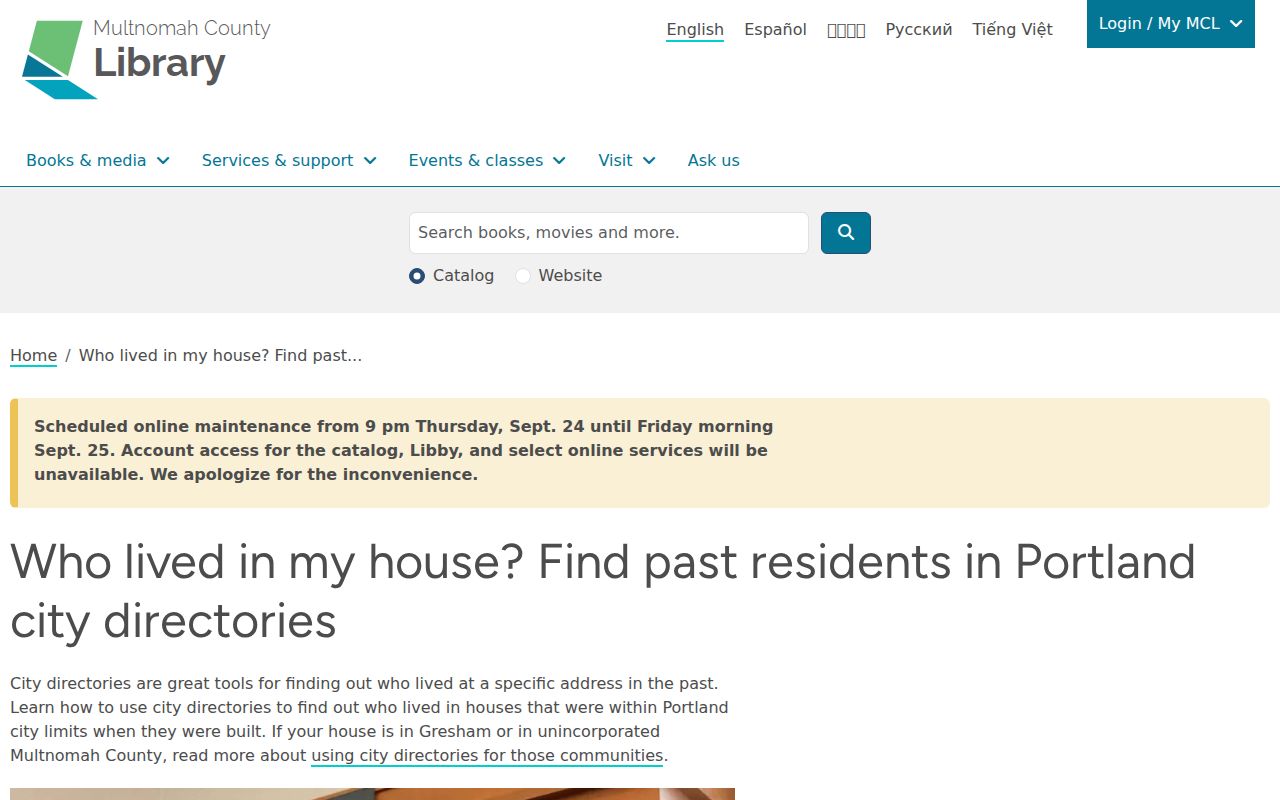
The guide is a research aid for this local shelf, not evidence that every directory year is digitized online.
Portland's Oregon City Directory Guide
Portland directories from 1930 onward include a reverse “Street and Avenue Guide.” It is arranged by street, block and address, and in most years the section is printed on pink or green paper. That is the address-keyed part of the collection: find the street, move to the block, then check the house number. The entry is abbreviated and names the person or business tied to that address for that edition. It offers a yearly clue, not a full list of every person who stayed in a home.
Before 1930, Portland's volumes do not have an address-by-street section. A known later name is the useful starting point for going back through the earlier books. In any year, check both the street guide and the alphabetic entry when available; the name section can clarify an abbreviation and add an occupation or business link. A gap can reflect a move, a boundary change, a skipped annual volume, or an omission, so it should not be treated as proof that no one lived there.
Note: The printed color is a locator, not a separate record type; the library describes pink or green paper in most years.
| Directory year | What changes for the researcher |
|---|---|
| 1863 | First Portland directory, issued by S. J. McCormick Company |
| 1863–1929 | Alphabetical resident and business listings; no reverse street section |
| 1930 onward | Street and Avenue Guide adds address-order lookup, often on pink or green paper |
| 1931–July 1933 | Citywide address reassignment makes old/new number checks essential |
Oregon Directory Address Crosswalk, 1933
Portland began a citywide address reassignment in 1931 and completed it in July 1933. The work changed many street names and house numbers and established the five directional quadrants. The city archive's cross-reference is a practical bridge between a directory address and a later map or parcel. Its record identifies Ordinance 61325, dated February 28, 1933, and a report filed as D/51536.
The Portland City Archives renumbering record provides the old-to-new reference used to translate an address across the change.
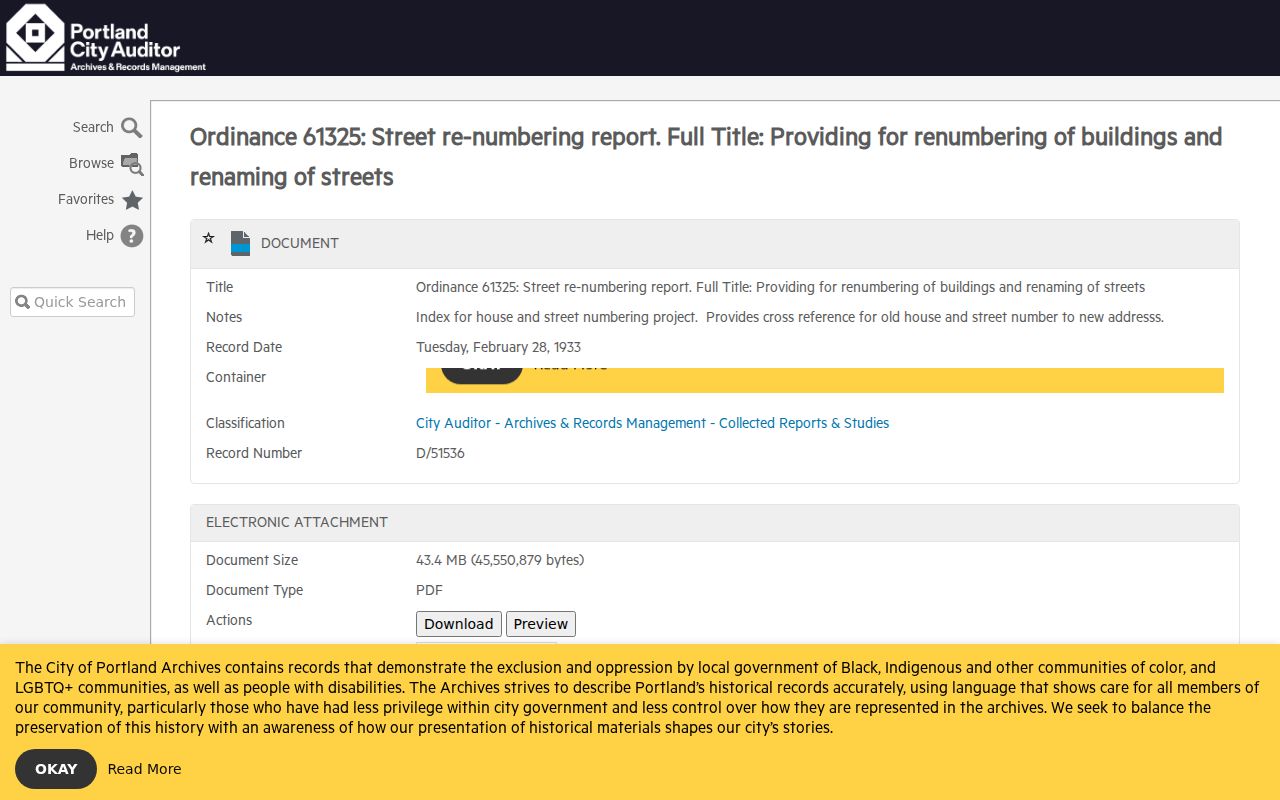
For directory searches, check the old address in 1930 and 1931, then search both old and new forms in 1932 and 1933 because neighborhoods changed at different times. Portland made another Southwest readdressing change in 2020. A crosswalk prevents a search from discarding the right household under a number that no longer exists.
Oregon's Gresham and East Suburban Directories
The Gresham and East Suburban volumes have address sections of their own. Their coverage reaches parts of today's Portland, including Cully, Parkrose, Brentwood-Darlington, Powellhurst-Gilbert, Hazelwood, Mill Park and Centennial. The library's examples place these areas outside Portland until the 1980s. A present-day city label therefore cannot tell you which directory a historical address belonged in; check the location and boundary for the year being studied.
Tscheu Publishing's rural directories offer another kind of address clue. The Multnomah collection includes series for many Oregon localities from the late 1950s through the late 1970s, with maps of rural routes and rural-route box locations. The coverage is uneven and depends on the locality. A route box in one edition cannot be treated as a modern street address, and a missing name may mean that the chosen run does not cover that place.
Ask the library whether it holds an edition for the right community and year before shifting to a broad statewide search.
Note: Gresham and East Suburban are separate search targets, even when a present-day address carries a Portland label.
Decode an Oregon City Directory Entry
Portland's alphabetical pages favor the head of a household. A wife may appear by first name in parentheses after her husband's name; an adult child may have a separate entry; a deceased husband may be noted in parentheses after a widow. A live-in domestic worker may also have an entry. Occupation or business affiliation can help tell two people with similar names apart, but it does not prove that every relative or lodger appears in the book.
| Name line | Surname and given name, with head-of-household emphasis |
|---|---|
| Family notation | A spouse's first name may be in parentheses; a widow may be linked to a deceased husband |
| Occupation | May show a trade or business affiliation |
| Address | Home address in the alphabetic listing; check old and new forms across the 1930s change |
| Street entry | Street, block and number with an abbreviated person-or-business marker |
| Other sections | Classified businesses, government, churches, schools and organizations |
- Criss-cross directory
- A street-and-address section, also called a reverse directory; Portland's Street and Avenue Guide serves this purpose from 1930 onward.
- Householder index
- An alphabetical search aid centered on a primary name; it does not promise that every person in a home is named.
- Abbreviation key
- The volume's guide to shortened marks; consult it or ask library staff before expanding an address entry.
Classified pages group businesses by type, with examples such as barbers, lumbermills, attorneys and dairies. Separate sections list public agencies and community organizations. Those sections can supply useful context for a family history, but they are not resident rolls.
Oregon Directory Catalogs and Archives
For cities beyond the documented Portland-area runs, Oregon has no single complete online directory collection identified in the research. The Oregon Historical County Records Guide maps selected series among county offices, the State Archives, museums and libraries. It is a guide to records and custody, not a guarantee that a city directory will be listed or scanned. Search the relevant local library catalog as well, then ask staff to check uncataloged or incomplete runs.
The Oregon ArchivesSpace catalog can help locate archival collections by name, place or organization.
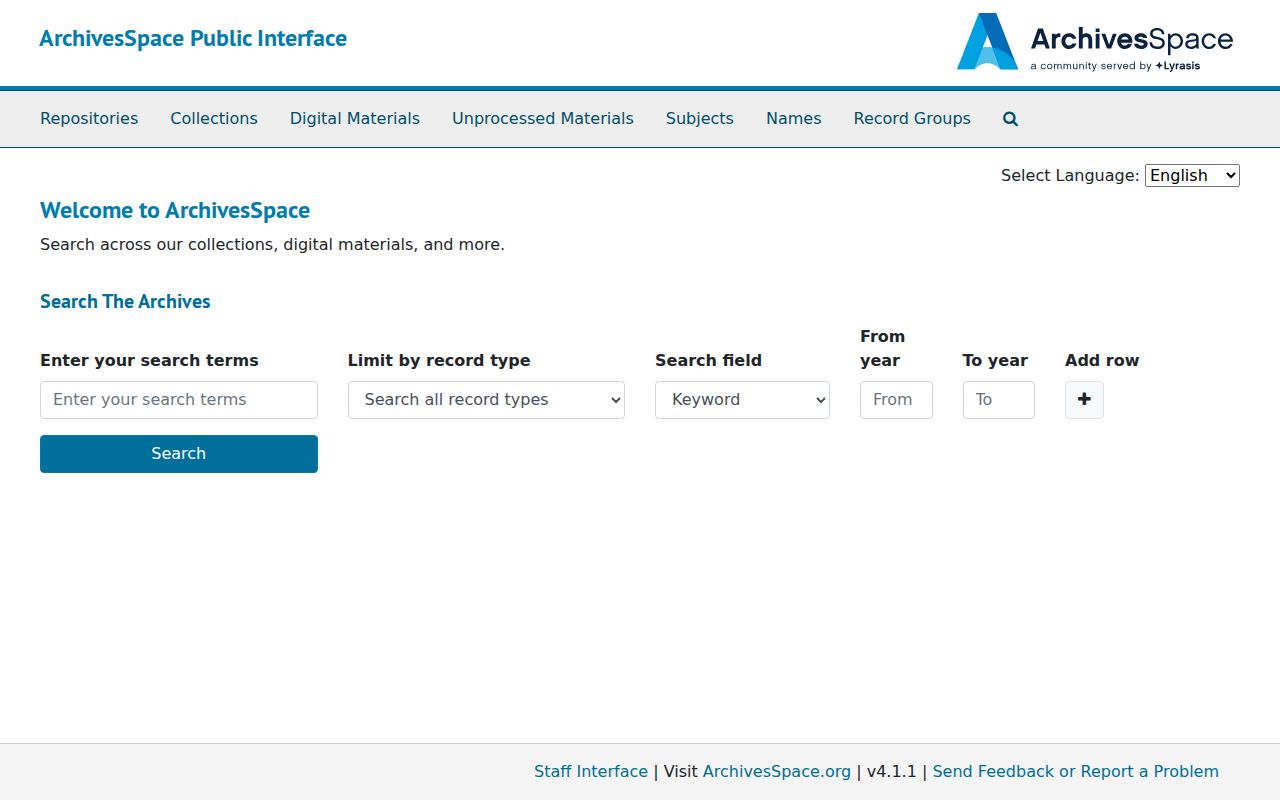
A catalog result points to a collection or repository; it should not be read as proof that a directory volume is digitized or viewable from home. The State Library digital platform moved to full-text search in October 2024 and then held more than 160,000 Oregon government publications. Northwest Digital Heritage reported more than one million items across more than 300 libraries, museums and heritage groups in Oregon, Washington and Idaho in March 2025. These broad portals may add context, but verify the exact title and access terms before citing a result.
Note: Catalog discovery and online image access are separate steps; check repository rules before relying on a digital result.
Oregon Indexes Behind Directory Research
Library indexes can help connect names across years when a directory entry is thin. Multnomah County Library's Oregon index guide lists Portland birth and death ledgers for 1881–1917, the Oregon Death Index for 1903–2008, marriage indexes for 1906–1924 and 1946–2008, and a divorce index for 1925–2008. The death index gives a name, county, date and record number, not age or cause of death. An index is a pointer, not the full certificate or court file.
Newspapers can supply a dated address clue that a directory lacks. Multnomah County Library has searchable Oregon Journal issues from 1902–1982 and Historical Oregonian issues from 1861–1987. Search a name and an address in quotation marks, including both old and current forms, then try terms such as sale, obituary, funeral, permit or classified. For other towns, Historic Oregon Newspapers has local titles with runs that vary by paper.
The Oregon Historical Records Index keeps surnames in the spelling found in source records. Search the surname first, then add a given name or county to narrow results; the State Archives warns that periods were dropped from later data entry. These indexes and papers are supporting evidence. Confirm a death, estate, transfer or family connection with the record custodian that holds the source document.
Trace a Household Across Oregon Directory Years
A Portland directory is strongest when read beside sources with different dates and limits. Directories record a published year's name or address, while a census is a household snapshot taken during enumeration. Federal census schedules are released under a 72-year rule; Oregon state and territorial schedules can be found through State Archives references. Keep the town boundary and the exact year with each note, especially when a family moved between Portland, an East Suburban run or a rural route.
- Write down the person's name, known city and approximate year, then check which Oregon library holds that town's directory.
- For a Portland address after 1930, use the street guide and then verify the abbreviated listing in the alphabetic section.
- For 1930–1933, convert the address and search both old and new forms; for 1863–1929, work backward from a known name.
- Compare the nearest released census year, noting that its household is a snapshot and may not match a directory year exactly.
- Use a newspaper notice or historical index to check a move, death or family link, then confirm important facts in the original record.
A name that disappears may mark a move, death, boundary change, missed edition or omission. Compare the next known address, household names and dates rather than assigning one cause from a single blank. For current parcel ownership or today's street chain, use the local assessor and recorder path; a historical city directory documents occupants and businesses, not title.